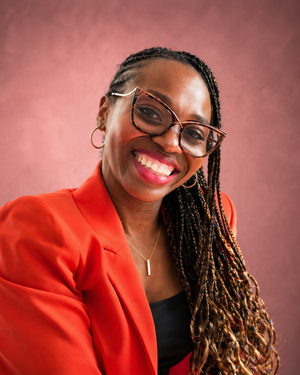
Ep.4/ What 17 Years in the Classroom Taught Me About Leadership
And How I Knew I had to Go.
LISTEN NOW
People don’t always think of the classroom when they think about leadership.
They think about boardrooms.
Corner offices.
Big decisions and even bigger titles.
But if you really want to understand leadership—real leadership, the kind that requires you to show up fully, think quickly, and hold space for other people while still moving forward—you spend time in a classroom.
Seventeen years will teach you a lot.

Ep.4/
What 17 Years in the Classroom Taught Me About Leadership
It will teach you how to read a room before a word is spoken.
You learn to notice energy.
You see who is present and who is checked out; who is confident and who is shrinking in their seat.
You learn that what people say is only part of the story.
And if you’re paying attention, you adjust on the fly.
Not because it’s convenient, but because it’s necessary.
Rooms like that will teach you how to lead without control.
The truth is you can plan the lesson, prepare the material, and you can even set the intention for the day.
And then…something unexpected will happen. Every time.
A question you couldn’t have possibly anticipated.
A moment that shifts the entire direction of the room.
A need that wasn’t visible when you started.
Or an immature joke and an ill timed bodily function from a teenaged boy, because, well, kids are gross.
Leadership in that space requires flexibility.
You learn quickly that control is not the goal. It’s actually responsiveness.
In the classroom, you will learn how to hold people accountable without losing connection because leadership is not just about delivering information.
It’s about making sure people grow.
And growth requires honesty.
It requires you to say the hard thing, to set the standard, to expect more—while still making people feel seen, supported, and capable.
That balance is not easy, but it is essential.
It will teach you that presence matters more than performance.
You can have the perfect plan, but if you are not grounded, not aware, not fully present in the moment, the room will sense it. And that is like blood in the water for seventh graders.
People respond to how you show up more than what you say.
They respond to clarity, and steadiness, and to someone who knows where they are going, even when the path shifts.
And maybe most importantly, the classroom will teach you that leadership is not about being at the center of attention.
It’s about what happens because you paid attention.
Did people grow?
Did they feel seen?
Did they leave with something they didn’t have before?
That is the measure, not how impressive you looked while doing it.
What I learned in the classroom didn’t stay there.
It followed me into every space I’ve entered since.
Into boardrooms and planning meetings.
Into stages and speaking engagements.
Into strategy sessions and leadership development work.
Because once you understand leadership at that level, it sticks with you.
You stop focusing on appearances.
You start focusing on impact.
Years ago, I began to see how occupying spaces outside of teaching with the skillset I had carefully honed in the classroom was making a real impact.
I also began to understand that being in the classroom was no longer in alignment with the leader I had become.
Suddenly, it felt tight and I was seeing where things weren’t adding up where the system was concerned (or rather unconcerned about what’s really best for students).
Eventually I realized that I was no longer growing in the classroom, I was grinding. It wasn’t about meeting standards, it was about meeting mandates that were unachievable at best.
The environment became toxic and I had to make a choice. Was I going to become a lifer? Showing up in the morning, clocking in, and dragging my soul 8 hours closer to retirement by the end of the day? Or was I going to take everything I had worked meticulously to craft for myself as a professional woman and bet it all on me?
I chose me.
The classroom also taught me something else.
Something quieter, but just as important.
It taught me how to trust myself.
To make decisions in real time.
To adjust without losing direction.
To stand in front of a room and hold it, even when things don’t go as planned.
That kind of trust doesn’t come from theory.
It comes from practice. It comes from having to teach through COVID-19. It comes from hearing, “We really want you to do a show with the kids, but, there is not budget. You’ll come up with something though.” It comes from standing your ground when your peers are more concerned about protecting their own necks than telling the truth.
It comes from showing up to do your job on days when you are sick, bereaved, stressed out, or just plain old tired.
From showing up again and again, refining, learning, and leading anyway.
So when I talk about leadership now, I’m not talking about something abstract.
I’m talking about something I have lived.
I’m talking about something tested.
Something refined in real environments, with real people, in real time.
And if you’re in a season where you are being asked to lead differently—to stretch, to grow, to transition into something new—this matters.
Because leadership is not about having all the answers before you begin.
It’s about being willing to show up, stay present, and move with intention as you figure it out.
Everything I teach, everything I build, everything I guide leaders through is grounded in that understanding.
Leadership is not performance. Though I am a hell of a performer…more on that later.
It is presence.
It is responsibility.
It is the ability to move people and outcomes forward without losing yourself in the process.
If you’re ready to lead that way, stay here.
Because this is the work.
And you don’t have to learn it alone.